
System Performance Enhancement
Improving machinery performance, extending asset life, and increasing throughput — from targeted production line tweaks to software upgrades that change how the line behaves without touching the hardware.
Get more from the line you already run — without buying new machines.
PITCO Engineering's production line optimization services are about more than small adjustments — we reduce cycle times, improve OEE and throughput, and engineer out the bottlenecks on the line you already run, setting you up for sustained success across automotive, life sciences, food and beverage, and beyond.

Engage a single capability or the full optimization pipeline — every engagement starts with understanding your line, your constraints, and your goals.
Improving machinery performance, extending asset life, and increasing throughput — from targeted production line tweaks to software upgrades that change how the line behaves without touching the hardware.
Identifying the constraints that limit your throughput, then engineering them out — motion-profile tuning, sequence re-ordering, recipe optimization, and line rebalancing to squeeze the available capacity out of the equipment you already own.
Creating clear, effective SOPs that ensure your operations run smoothly and consistently — maximizing both efficiency and safety, and giving operators a reliable reference for every scenario the line can encounter.
Assessing your current hardware setup and recommending targeted enhancements — sensor upgrades, drive replacements, network infrastructure improvements — that deliver measurable performance and efficiency gains with minimal disruption to production.
Developing optimization solutions that are truly customized and effective — built through close collaboration with your operations and engineering teams so the result fits your actual workflow, not a generic template.
Ongoing support after implementation — guidance and further adjustments as needed as performance data accumulates and the line evolves. The work doesn't stop at handoff; it continues as long as the operation benefits from it.
Production line optimization is the systematic work of getting more output, quality, and uptime from a manufacturing line that's already running — by reducing cycle times, eliminating bottlenecks, and improving overall equipment effectiveness (OEE) instead of buying new machines. It tunes the equipment, software, sequence, and procedures you already own so the line runs faster, more consistently, and with less waste.
For PITCO, that's controls and automation engineering applied to a live line: motion tuning, sequence and recipe changes, line rebalancing, targeted hardware upgrades, and SOPs — not just a monitoring dashboard. We specialize in automotive, life sciences, and food and beverage, where uptime and consistency aren't negotiable and every percentage point of efficiency has a dollar value attached.
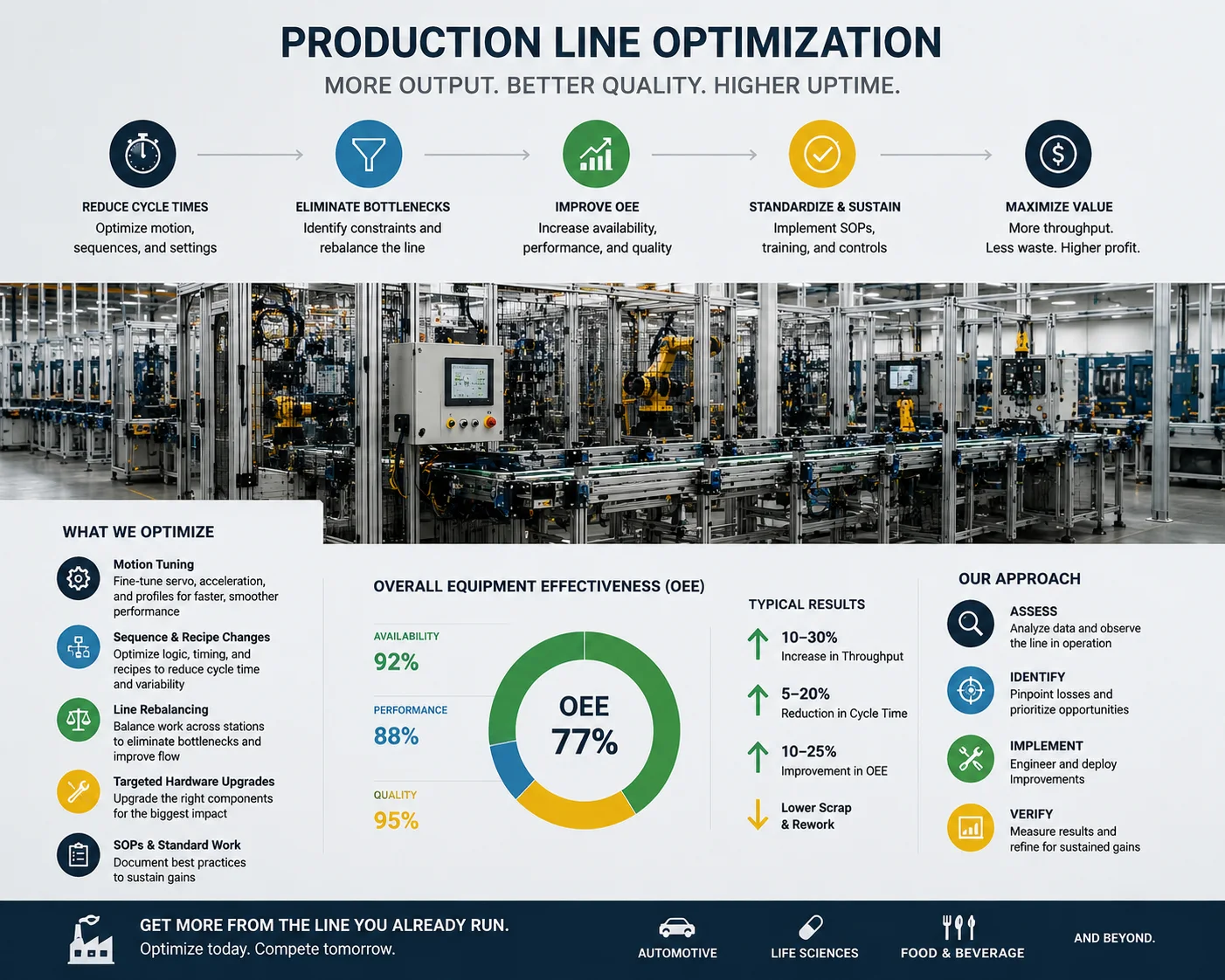
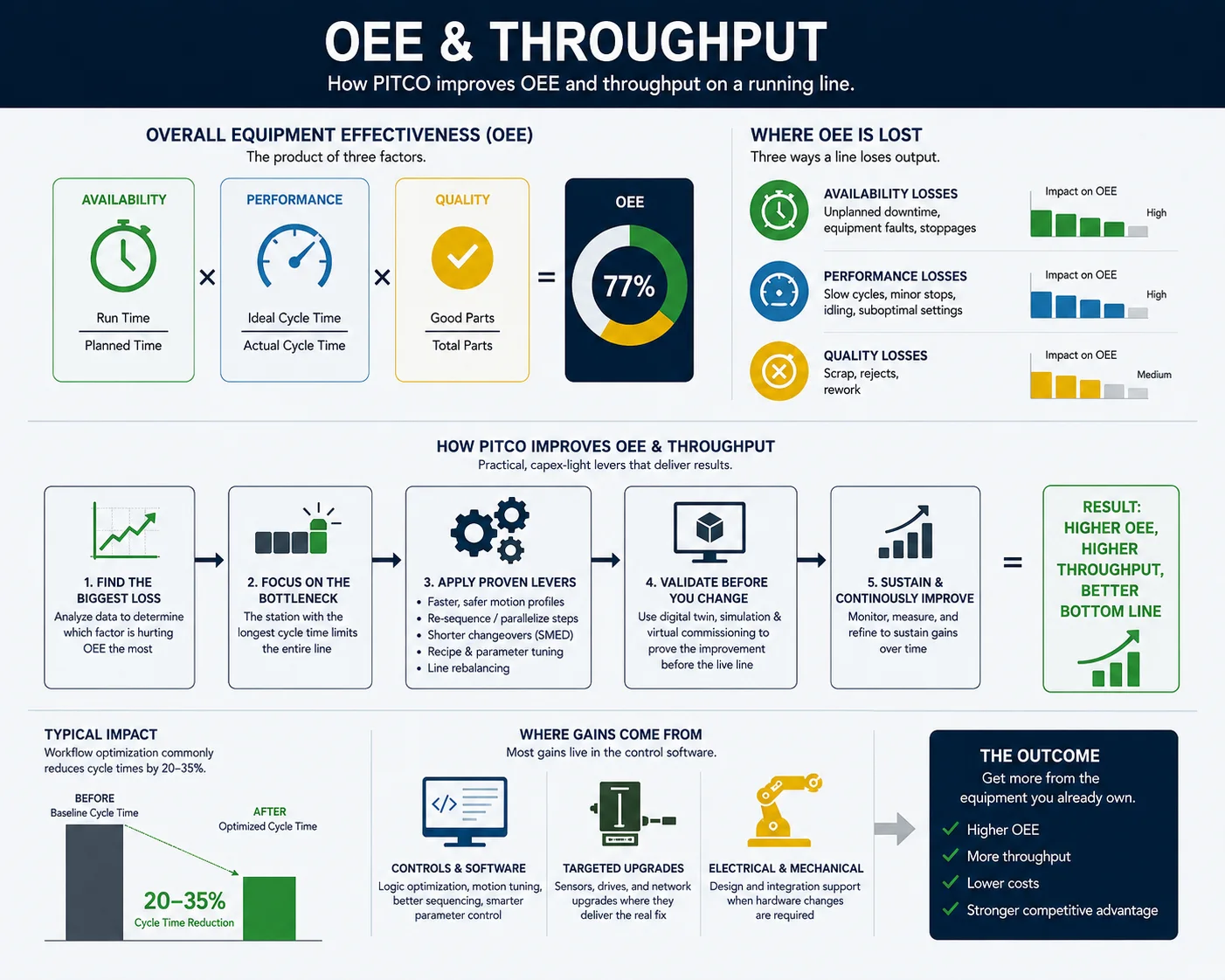
Overall equipment effectiveness (OEE) is the product of three factors — availability, performance, and quality. A line loses OEE to unplanned downtime, slow cycles and minor stops, and scrap or rework. We start by finding which of the three is bleeding the most output, then engineer it out: the biggest throughput gains usually come from the bottleneck station — the one whose cycle time runs longest — so that's where the work is focused first.
From there the levers are practical and capex-light: faster, safer motion profiles; re-sequenced or parallelized steps; shorter changeovers (SMED); recipe and parameter tuning; and line rebalancing so no single station caps the rest. Workflow optimization of this kind is commonly reported across the industry to cut cycle times by roughly 20–35%. Where a change is risky to trial on a live line, we can prove it on a digital twin with simulation and virtual commissioning before touching production.
Many gains live in the control software, not the steel — so optimization often overlaps with our controls and PLC software development, and where a sensor, drive, or network upgrade is the real fix, with the electrical and mechanical design work behind it. The point is the same throughout: get more from the equipment you already own.
The questions operations and engineering teams ask before they spend on capacity.
Production line optimization is the systematic work of getting more output, quality, and uptime from a manufacturing line that's already running — by reducing cycle times, eliminating bottlenecks, and improving overall equipment effectiveness (OEE) instead of buying new machines. It tunes the equipment, software, sequence, and procedures you already own so the line runs faster and more consistently.
Find the bottleneck station first — the step whose cycle time runs longest — because the whole line moves at its pace. Then attack that station: tune motion profiles, re-sequence or parallelize steps, shorten changeovers with SMED, and rebalance work across stations so no single step caps the rest. Workflow optimization of this kind is commonly reported across the industry to cut cycle times by roughly 20–35%.
Overall equipment effectiveness (OEE) is availability × performance × quality, so a line loses OEE to unplanned downtime, slow cycles and minor stops, and scrap or rework. Improve it by measuring which of the three factors is costing the most output, then engineering that loss out — predictive maintenance and reliability for availability, motion and sequence tuning for performance, and tighter control and inspection for quality.
Get more from the equipment you already own: eliminate the bottleneck, cut changeover time, raise asset utilization through better scheduling and reliability, and tune the control software so cycles run faster and minor stops disappear. Most lines have hidden capacity locked up in downtime and unbalanced stations — recovering it is far cheaper than capital equipment and is the core of production line optimization.
Production support is the ongoing engineering that keeps a line productive after handoff — troubleshooting, adjustments, software changes, and continuous improvement as performance data accumulates and the line evolves. It's the natural next step after installation, commissioning, and FAT/SAT, turning a one-time build into a line that keeps getting better.
Tell us about your line — an engineer will be in touch.